From archives to access: digitising NSW’s historical records
The scale and breadth of the NSW State Archives Collection – which comprises more than 14 million items – can be difficult to comprehend. To offer a glimpse into this vast collection, we spoke with Anna Gray, Archivist, Collection Digitsation at Museums of History NSW, about three recent digitisation projects. Through specialist imaging, community collaboration and careful conservation, these projects are preserving significant records and making unique stories from NSW history more accessible to everyone.
State Rail Authority negatives
Why was it important to digitise the State Rail Authority negatives collection?
The State Rail Authority negatives collection is significant because it provides a detailed visual record of the development of rail transport in NSW and documents the activities of the railway system, its infrastructure and workforce. It also includes images that promote the railway and rail travel, and documents notable events such as the 1954 Royal visit in which Queen Elizabeth II travelled through NSW by train. The collection forms part of the archival material transferred to the State Archives Collection when the in-house State Rail archives closed in 2000.
Digitisation is essential because it preserves vulnerable photographic negatives, improves access for researchers and the public, and ensures this important record of the state’s transport and social history remains available for future generations.
Given that many of the negatives are at risk of – or already showing signs of – chemical degradation, what special measures were needed during digitisation?
The collection includes both glass and acetate negatives. The acetate portion of the collection was targeted for digitisation as acetate negatives are an at-risk format that will deteriorate over time through a chemical breakdown known as vinegar syndrome, which can cause shrinking, curling, embrittlement, or emulsion damage. For severely damaged negatives, imaging may be a last-opportunity preservation action to capture information that may no longer be recoverable from the original object in the future.
Digitisation requires careful handling, condition assessment, controlled storage environments and specialised imaging techniques to safely capture the image content while minimising further damage to the originals.
Browse more from the collection
NRS-21573 – Glass plate and acetate negatives with ‘PR’ [Public Relations] prefix [State Rail]
NRS-22818 – Glass, photographic and acetate negatives (various)
Small Debts Registers
What kinds of information do the Small Debts Registers contain?
Small Debts Registers are records created by Courts of Petty Sessions throughout NSW. These courts were given authority under legislation passed in 1846 to hear claims for the recovery of debts of up to £10, providing an inexpensive and local way for people to pursue relatively small financial disputes.
The Small Debts Registers provide a window into the everyday economic and social life of 19th- and early-20th-century NSW communities. The registers document cases brought before the courts to recover debts and typically include:
- name of the plaintiff (the person making the claim)
- name of the defendant (the person being sued)
- the cause of action or reason for the claim
- amount of the original claim
- court costs
- the court’s judgement
- amount awarded by the judgement.
Why were local history groups invited to assist with this digitisation project? Were there any challenges in coordinating the digitisation work with local history groups?
Digitisation is only part of the process. The other part of this project was creating accurate indexes to allow people to search the records online and find relevant entries quickly. Community volunteers were enlisted to assist with this indexing work. These groups were engaged due to their interest in history and their enthusiasm to contribute to the work MHNSW does. As local history groups often have deep knowledge of people, places, surnames and communities in their region, they are well placed to help identify and index records accurately. Partnering with community organisations enables MHNSW to make more records available online than would otherwise be possible using institutional resources alone.
The most important thing when managing multiple groups is maintaining consistency, accuracy and quality across digitisation and indexing activities. The DigiVol platform was used to support and standardise the indexing work and used as a communication tool throughout the project.
Settlers’ Muster Book
What prompted the decision to digitise the Settlers’ Muster Book? Given its fragile condition, what were the main challenges in preparing it for digitisation?
MHNSW collaborated with the NSW Parliamentary Library to digitise the Settlers’ Muster Book 1800, an invaluable record that has been inscribed on the UNESCO Australian Memory of the World Register.
The Muster Book provides a snapshot into life during this period of early European settlement. The volume comprises several lists which record:
- land and stock held by free settlers, and emancipated or expired convicts, 1800
- land and stock held by officers, 1800
- people who are off the Government Stores, c1801
- lists of persons, c1801
- land and stock held by free settlers, officers, or emancipated or expired convicts, 1802.
The decision to digitise the Settlers’ Muster Book 1800 was driven by both its historical significance and the need to improve public access to a unique record. The project made the volume available online for the first time, allowing researchers, family historians and the wider public to explore its contents without handling the original.
Was any special equipment, set-up or imaging approach required to digitise the Settlers’ Muster Book safely?
Considerations when digitising included:
- careful support of the volumes to avoid strain on the binding
- minimal handling of fragile pages
- minimal pressure (no glass) used when digitising on the book scanner
- controlled lighting to protect the document while ensuring legibility
- high-resolution imaging to capture faint entries
- preservation-focused workflows that reduced the need for future handling of the original record.
Accessing the State Archives Collection
For more information on how to search for records in the State Archives Collection, guidance is provided on our How to use the State Archives Collection page.
Published on
More stories from the Archives

State Dockyard, Newcastle
This series documents the activities of the State Dockyard Newcastle between 1953 and 1983 through photographs, negatives, slides and microfilm. There are 8,500+ photos in this series
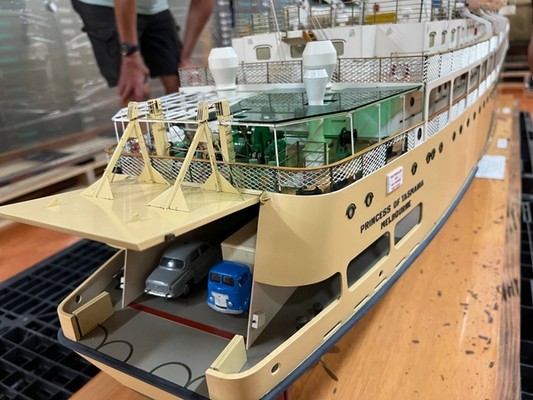
Shipshape: conserving a model of the Princess of Tasmania
Learn how our conservators addressed metal corrosion on a striking 1950s ship model in the State Archives Collection
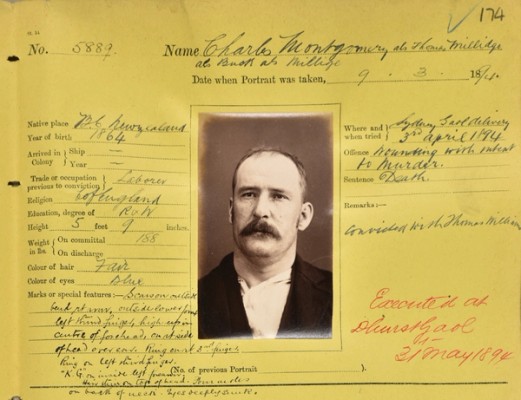
Groundbreaking crimes from the archives
Within the sandstone walls of the Justice & Police Museum are countless stories of crime, courage and justice – some famous, many forgotten
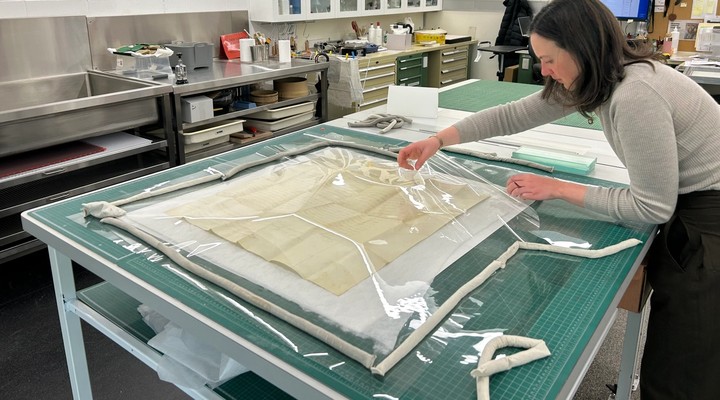
Flat out access: unfolding the parchment pardon of Samuel Henry Horne
The conservators at the Western Sydney Records Centre treat items from across Museums of History NSW collections. A recent example is the 1832 absolute pardon of convict Samuel Henry Horne